

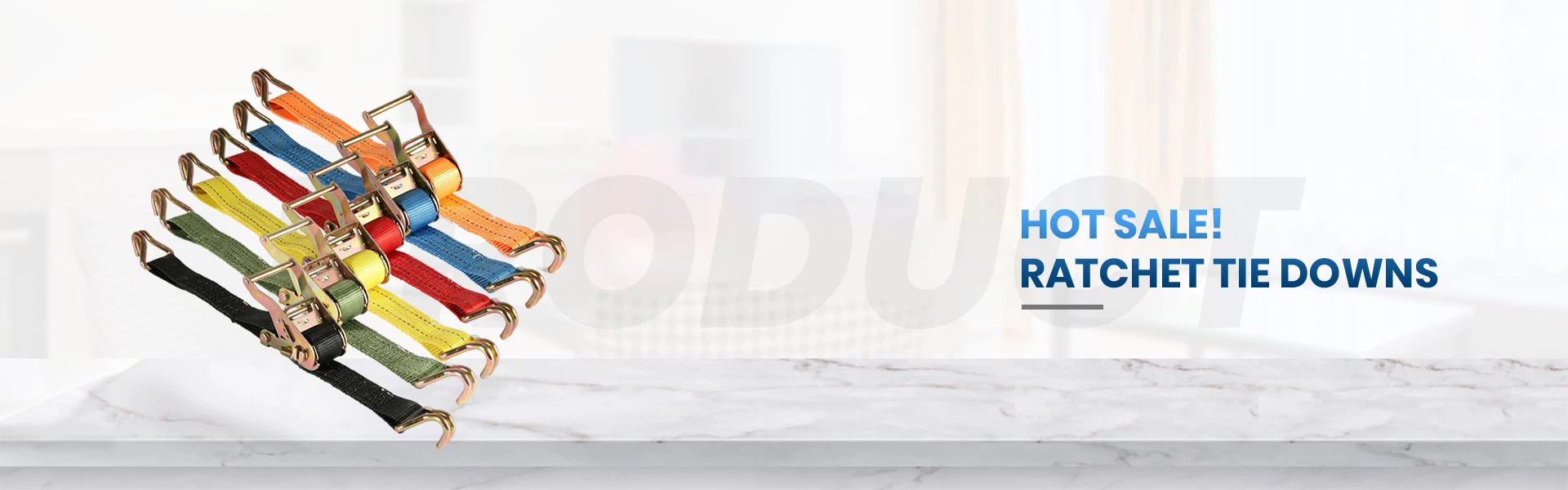


High Quality Ratchet Straps
What is High Quality Ratchet Straps
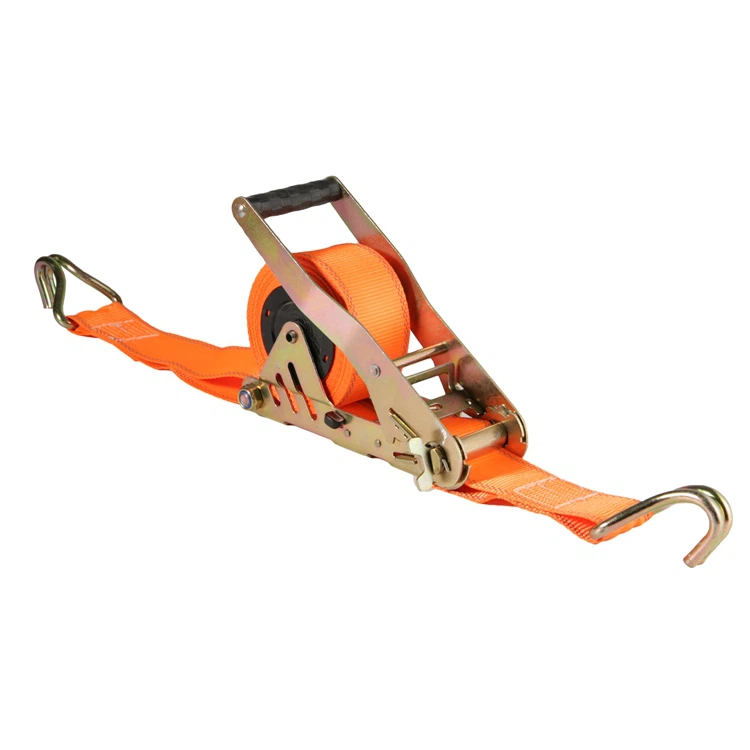
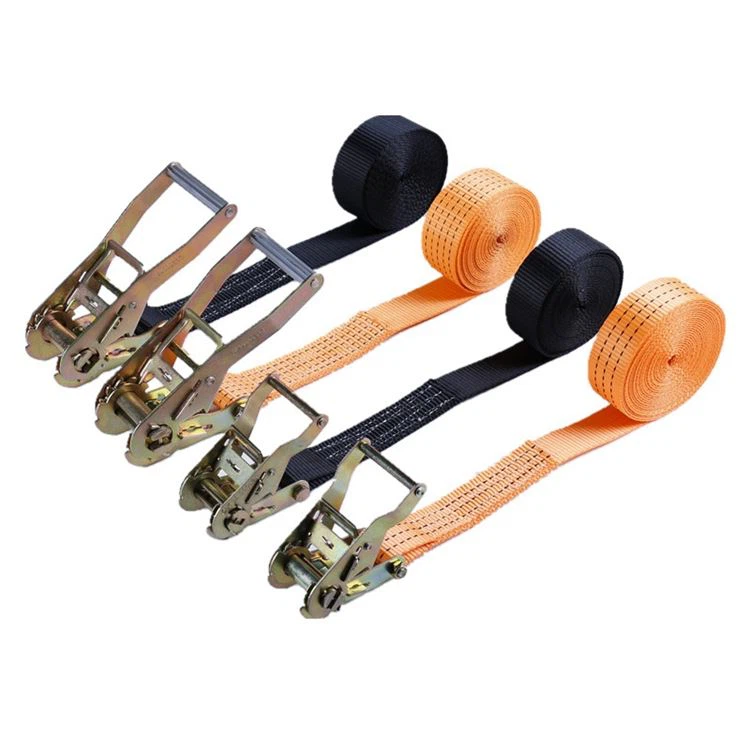
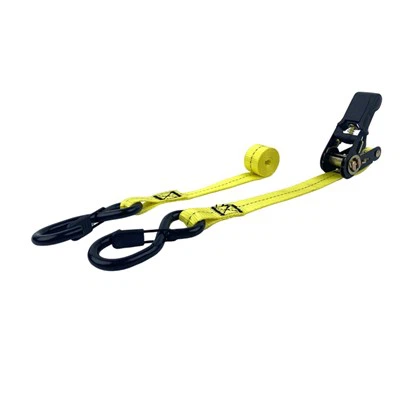
A high quality ratchet straps (also known as a ratchet strap, a lashing strap or a tie down) is a fastener used to hold down cargo or equipment during transport. Tie down straps are essentially webbing that is outfitted with tie down hardware. This hardware allows the tie down strap to attach to the area surrounding the cargo or equipment, loop over the cargo or equipment, and/or attach to the cargo or equipment. It usually also includes a method of tensioning the strap, such as a ratchet.
Benefits of High Quality Ratchet Straps
Variety of sizes:It does not matter if your situation is lightweight (like securing your load to a roof rack, for example). There are suitable mini versions of high quality ratchet straps with strength ratings of up to 1,500kgs. For larger applications, you can get high quality ratchet straps that go up to 20m in size and offer a strength rating of up to 10,000kgs.
Variety of fittings:High quality ratchet straps come with a variety of fittings that can be used in a number of applications depending on your needs. The fittings they can come with are: flat snap hooks, e-track double stud fittings, d-rings, e-track fittings, flat hooks, chain extensions, vinyl coated wire hooks and many more.
Effortless:Due to the ratcheting system of these tie down straps, you are given a mechanical advantage when it comes to tightening the load to make sure that everything is secure. They also make the job of loading and offloading large and bulky cargo easier and faster without needing a lot of man power.
Safe:Since your cargo is safely secured, you can transport it with peace of mind knowing that it will not fall off the trailer, pick-up truck or roof rack and damage the cargo in the process. This is especially important in high-traffic areas where the safety of others and their property is a major concern.





why choose us
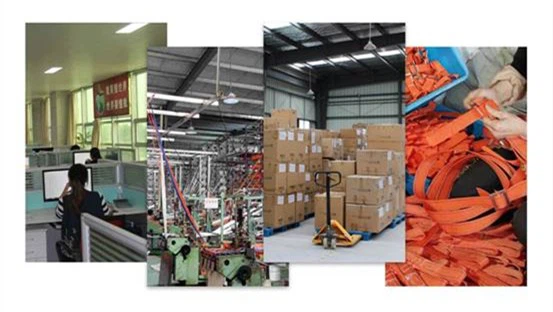
Professional Team
We are an original manufacturer with more than 10 years experience,we are very professional.
Custom Service
We support sample service, you can order samples to test the quality of our products before deciding whether to cooperate with us.
Online Service
We can provide customized services according to your specific needs, you can contact us at any time.
Our products
The price of our products is very competitive in the market, because we produce the research and development products by ourselves, we are the original manufacturer.
How to Store High Quality Ratchet Straps
Remove the webbing from the ratchet handle. Taking the strap apart can help them last longer while they're not in use, as there will be no tension on the webbing when it's removed from the handle. This limits how much the webbing stretches over time, boosting the material's lifespan.
Been out in the rain? Make sure your straps are dry before you put them away. Not only can the webbing develop mould and mildew when it's stored wet, the ratchet handle can corrode.
Keep away from heat and UV rays. Make sure you choose a cool, dry location to store your high quality ratchet straps, as the sun's rays can break down the webbing material over time.
Even if you're not using your high quality ratchet straps regularly, you should inspect them often to check for signs of moisture and to ensure there are no obvious signs of wear and tear. It's a good idea to lubricate the ratchet mechanism while you're at it, too.
How To Keep Your High Quality Ratchet Straps In Good Condition
Store them away from the elements
Although a good ratchet strap will be manufactured with UV-resistance, it's good practice to high quality ratchet straps out of sunlight. Not only will that reduce UV exposure, it will also prevent direct heat and weather from reaching the straps.
Store straps in a dry area to reduce the chance of mold and mildew. The goal is to mitigate any factors that will make the material brittle or compromise its strength.
If a strap becomes wet or saturated, allow it to air dry thoroughly before winding it up and wipe away any moisture from the ratchet mechanism as well.
Keep webbing folded up and secured
When not in use, the clean, dry webbing should be folded or rolled up neatly to avoid twists and kinks. Secure the webbing bundle with a Strap Wrap or similar. This will make it more compact for storing, and easier to take out and use when you need them next. No one wants to reach for a strap and be faced with a tangled mess.
Clean them periodically
Depending on what you're hauling, over time your strap webbing will most likely absorb grease, grime and road dust. To preserve the longevity of your strap, take a moment to occasionally clean the webbing thoroughly with mild soap and water.
Similarly, cleaning and maintaining the ratchet mechanismwill keep it operating smoothly time and time again. The last thing you want is to be rushed on a job and your ratchet mechanism sticks or hits grit.
Ratchet strap construction
To understand how this equipment works, you first have to look at what high quality ratchet straps are made of. The most commonly-offered material is polyester, although other fabrics like nylon are available. Polyester has the strength and low stretchiness necessary to ensure the safety of your haul for your whole trip. Other benefits of polyester include resistance to UV rays, mildew, mold, and many common chemicals.
Tie down styles
Because there are so many possible applications, high quality ratchet straps are available in a diverse selection of styles. When choosing the right one for you, there are several factors to consider.
Width
The first is the strap width. This has a huge impact on the working load limit (WLL) of a high quality ratchet straps. This rating is incredibly important – it lets you know exactly how much weight that piece of rigging is capable of securing. Using a ratchet tie down strap with an inadequate WLL can lead to damaged cargo, increased risk of personnel injury, and other safety hazards.
You calculate WLL by dividing the break strength (BS) – the point at which the strap will fail – by three, and is dependent on the lowest-rated strap component. For example, if the strap is rated for 3,000 lbs. but the end fitting is only rated to 2,500 lbs., the WLL will be 2,500 lbs.
You'll find information like WLL and break strength included on a tag that comes attached to the ratchet strap.
Strap widths are generally available between 1" and 4":
1" straps are generally used for light-duty applications, with a WLL of up to around 1,000 lbs.
2" straps are the most commonly-used option because they are available with E- and L-track compatible hardware. Their WLL can be up to 3,333 lbs.
3"and 4" straps are the optimal choice for heavy-duty tie down applications. The 3" strap has a WLL of around 5,400 lbs., while the 4" strap is 5,400 lbs. and above!
End hardware
Another factor involves the end hardware. As mentioned above, some end fittings work with E-track and L-track. Other options include wire hooks, chain ends, and more – all with slightly different application suitability.
The end hardware you choose will generally be informed by the type of attachment points you have (or plan to have) in your trailer, as well as your available space. For example, you might choose a wire hook if your attachment point is in a narrow, harder-to-reach space.
If you have E-track or L-track already installed on your flatbed, choosing hardware specifically designed for those systems will streamline your securement process.
Assembly type
The last factor we will cover is assembly type - choose from full or endless. The full assembly consists of two sections, one with an end fitting and a ratchet, and the other with an end fitting and a fixture-less end. These two straps thread together to create your tie down. A full assembly is the standard pick for most applications, as it allows for more versatility in your setup.
The endless assembly is frequently used to bundle items together, as it consists of just one strap with a ratchet and a fixture-less end. You simply feed the fixture-less end through the mandrel to create a solid loop, then ratchet it to secure.

● For articles less than or equal to 5 feet in length and 1,100 pounds in weight, you need one tie down.
● If the article's weight exceeds 1,100 pounds and less than or equal to 5 feet, you need two tie downs.
● If the length exceeds 5 feet but less than 10, regardless of weight, you need two tie downs.
● If an article exceeds or equals 10 feet in length and is "blocked, braced or immobilized to prevent movement in the forward direction by a headerboard, bulkhead, other articles that are adequately secured, or other appropriate means," then secure it with one tie down every ten feet (or fraction thereof). Source: FMCSA
● If the article is greater than or equal to 10 feet in length and is not blocked to prevent forward movement, then it requires two tie downs for the first 10 feet of length, then one additional tie down for every additional 10 feet (or fraction thereof).
four types of end-fittings for High Quality Ratchet Straps
Flat hooks
These have a low-profile design and are typically made of steel or a similar metal. Compatible with flat anchor points, flat hooks can also hook to other ratchet straps.
J-hooks
Also known as wire hooks, J-hooks typically require an anchor point such as a D-ring or O-ring for the most stable fit. Many truck beds come equipped with these rings pre-installed.
S-hooks
Similar to J-hooks, S-hooks require an anchor point to attach to a vehicle. An important feature of S-hooks is that they have a locking function to prevent slippage.
Chain hooks
These must be connected to another chain end-fitting to function. They are typically forged from steel alloy and are incredibly strong, commonly used for automotive shipping or towing.
What Safety Standards Do High Quality Ratchet Straps Have to Meet?
European standard, EN 12195-2
For starters, all high quality ratchet straps should comply with the current European standard, EN 12195-2. Typically, a label is attached to the webbing of the strap to confirm this, along with a number of other technical specifications, like elongation, length, webbing material and lashing capacity.
The Highway Code, Road Traffic Act & Road Vehicles (Construction & Use) Regulations
These well-known publications each say the same thing about ratchet straps at a fundamental level: that any cargo secured using them must be just that - secure - and that it must not fall off the vehicle or destabilise it.The regulations also state that the driver and their employer are responsible for the safety of the load.
Health & Safety at work act
This one's not specific to high quality high quality ratchet straps, but applies nonetheless. In sections two and three of the act, it's made clear that all employers (and the self-employed) are legally required to do their bit to ensure the health and safety of their employees and those who could be impacted by any accidents involving a load.
Risk assessments must be completed where appropriate, suitable equipment (i.e. high quality ratchet straps with the correct load rating) must be supplied, and any employees involved in securing loads should be adequately trained.
Provision and use of work equipment regulations (PUWER)
The 1998 PUWER regulations state that all work equipment must be…
● Fit for purpose
● Inspected regularly for defects
● Maintained correctly
● Used only by those with the appropriate training
It's vital that all of the above regulations and guidelines are adhered to. Sure, accidents happen - but by doing your bit to maximise safety, you'll drastically reduce the likelihood of being involved in any of the 5,200 ratchet strap-related accidents that occur each year in the UK.
Taizhou Senkang protective equipment factory.One of the Professional Manufactures in the field of Cargo Lashing and Side curtain Buckles Industry.We focus on the Medium and High Quality market, with more than 10 years experience we have been successfully provided the Variety of Cargo lashings, including Ratchet Tie Down, Ratchet Buckle and Hooks to most European and the United States Clients.
Our Certificate
ISO9001,CE

Asked Questions
Q: What makes a good ratchet strap?
Q: What are the rules for ratchet straps?
Q: What is the life expectancy of a ratchet strap?
Q: How often should you replace ratchet straps?
Q: What is the safety factor of a ratchet strap?
Q: What should you not do with a ratchet strap?
Q: How much tension can a ratchet strap hold?
Q: Can ratchet straps fail?
Q: What is an endless ratchet strap?
Q: Do ratchet straps go out of date?
Q: Should you twist ratchet straps?
Q: How many ratchet straps do you need?
Q: Is there anything better than ratchet straps?
Q: What is better than ratchet straps?
Q: Are USA ratchet straps made in USA?
Q: What is the best color for ratchet straps?
Q: What did people use before ratchet straps?
Q: Which anchorage point is unsafe with ratchet straps?
Q: Are ratchet straps legal?
Q: How much heat can a ratchet strap take?
Hot Tags: high quality ratchet straps, China high quality ratchet straps manufacturers, suppliers, factory, Ratchet Tie Downs, Short Tie Down Straps with Hooks, Heavy Ratchet Straps, High Quality Ratchet Straps, Ratchet Straps and Tie Downs, Retractable Ratchet Tie Down
Previous
Motorcycle Cargo StrapsYou Might Also Like

Send Inquiry